There's a moment, familiar to anyone who's spent time with a large language model, when the machine says something wrong in a voice that sounds irrefutably right. The legal citation is fabricated, but the prose is flawless. The medical explanation omits a contraindication, but the tone is clinically reassuring. The financial summary relies on stale facts, but the summary sounds authoritative. This is not merely a bug. According to researchers at GenXis Research, it's a structural feature of how modern AI systems process and produce language and understanding it is essential for anyone building on, buying, or governing these tools.
The core concept is called the Honesty Gap: the distance between persuasive language and verified truth. It's the subject of a new research paper from GenXis Research titled The Honesty Gap: Words Vs. Math, and it reframes the AI reliability debate in terms that matter for practitioners, policymakers, and the public.
What is the honesty gap in AI?
The honesty gap, as defined by researchers Daryl Ledyard and Philip Tyler at GenXis Research, is not simply the rate at which AI systems make errors. It's the specific mismatch between linguistic confidence and verified grounding.
"The anxiety around artificial intelligence is not merely that machines can be wrong," Ledyard and Tyler write. "It is that machines can be wrong in fluent, reasonable, socially persuasive language."
This distinction matters. A calculator can be wrong, but it rarely presents its errors in a form that feels persuasive. Language models are different. They metabolize error into something that sounds reasonable not because they intend to deceive, but because language itself is designed to be flexible. Natural language allows approximation, metaphor, implication, emphasis, ambiguity, and context dependence. Those features make it humanly useful. They also make it a weak carrier of machine-grade certainty.
The central question is therefore: when does a sentence become a verified claim? Ledyard and Tyler, GenXis Research
The answer, according to GenXis Research, requires treating claims not as sentences but as structured tuples containing the statement itself, the domain of application, the truth condition, and the evidence requirement. Without those elements, language remains expressive but under-bounded. It may point toward a reality without specifying the procedure by which that reality is checked.
Why do AI models present false information with high confidence?
The mechanism behind high-confidence errors is rooted in how language models are trained to generate text. They're optimized for fluency, coherence, and plausibility not for verification. When a model produces a legal citation, it's not retrieving a stored document; it's generating language that statistically resembles legal citations. When it explains a medical condition, it's synthesizing patterns from training data that may not reflect the full evidence base.
The GenXis Research paper describes this as the "squishiness of words" an informal concept that captures how language can preserve signal but can also metabolize error. "A sentence can feel precise while remaining logically incomplete," the researchers note. Phrases like "this was handled responsibly," "the model is aligned," or "the evidence supports the claim" may be true, false, evasive, or meaningless depending on hidden definitions that the language itself never surfaces.
Over time, these small verbal deviations compound. The paper uses an analogy: a singer drifting slightly off pitch until the tonal center is lost. In AI systems, this drift appears as hallucination unsupported synthesis, citation-shaped language without source custody, and the confident packaging of unverified information.
The problem is especially acute because language models now operate in domains where verbal mistakes have real consequences. Legal drafting, medical triage, education, scientific writing, financial reporting, security analysis, and software development are all within reach of current systems. In each case, the danger comes from the mismatch between linguistic confidence and verified grounding.
How does the AI honesty gap impact user trust?
The honesty gap erodes trust not through dramatic failures but through quiet accumulation. Users learn to double-check outputs, which undermines the efficiency gains that AI is supposed to deliver. In professional settings, this creates a verification overhead that partially negates the productivity benefits of automation.
But there's a subtler effect. When AI systems consistently produce fluent, reasonable-sounding outputs even when those outputs contain errors users may stop noticing the gap between confidence and accuracy. The language itself becomes the measure of credibility. This is what the GenXis Research paper calls "vibes" and "slop": language that feels meaningful while carrying weak constraint.
The implications extend beyond individual interactions. As AI-generated text proliferates across education, journalism, and public communication, the baseline expectation for verified claims may shift downward. If fluent language becomes the proxy for truth, the entire information ecosystem becomes harder to navigate.
A parallel concern appears in educational research, though in a different domain. A 2025 analysis from the Show-Me Institute on The Honesty Gap in Education notes that "grades have become more and more disconnected from actual achievement." The authors observe that 90 percent of parents believe their children are performing at or above grade level, even though only about one-third of fourth- and eighth-grade students score at a proficient level on the National Assessment of Educational Progress (NAEP).
"We seem to have collectively lost our appetite for bad news," writes Cory Koedel, a professor of economics and public policy at the University of Missouri-Columbia. "Parents don't want to hear that their children are falling behind, and schools are reluctant to deliver that message."
The parallel to AI is instructive: when systems are rewarded for producing optimistic or confident outputs, the feedback loop can disconnect those outputs from underlying reality. Whether the domain is student achievement or AI-generated text, the honesty gap creates a situation where stakeholders receive information that feels useful but may not reflect what's actually true.
Can artificial intelligence be trained to be completely honest?
The GenXis Research paper is skeptical that honesty can be achieved through better training alone. The root problem isn't insufficient data or inadequate fine-tuning it's the nature of language itself. "Words can escape meaning," Ledyard and Tyler write. "They can rationalize, soften, blur, excuse, reframe, and drift."
In human psychology, these phenomena are visible in motivated reasoning, cognitive dissonance reduction, moral disengagement, and ethical fading. In AI systems, they manifest as the specific failure modes that the honesty gap describes.
The paper's proposed solution isn't less language but stronger grounding. Specifically, the antidote involves five components:
- Mathematical constraint: Embedding formal verification into the generation process so that outputs are checked against structured logic before delivery.
- Source custody: Maintaining chain-of-custody records for factual claims, so that assertions can be traced back to verified evidence rather than statistical inference.
- Deterministic checks: Using rule-based validation for high-stakes claims, where the cost of error is high and the tolerance for ambiguity is low.
- Calibrated abstention: Training models to decline to answer when confidence is insufficient, rather than filling the gap with plausible-sounding text.
- Evidence memory: Building systems that retain and reference the specific evidence supporting each claim, rather than generating text that resembles evidence.
The key insight is that verified claims require structured procedures for checking not just more training data or better language models. The GenXis Research paper explicitly defines a claim as a tuple containing the statement, the domain, the truth condition, and the evidence requirement. Without that structure, language remains expressive but ungrounded.
What are the ethical implications of the honesty gap in AI?
The ethical stakes of the honesty gap are highest in domains where false information has direct consequences for people's lives. A fabricated legal citation can lead to incorrect case outcomes. A medically plausible but incomplete explanation can result in harmful self-treatment decisions. An AI-generated financial summary based on stale facts can lead to poor investment decisions.
Beyond individual harm, the honesty gap raises systemic questions about accountability. When AI systems produce confident errors, who is responsible? The model developer? The deployer? The user who failed to verify? The GenXis Research paper doesn't resolve these questions, but it frames them in terms that make resolution tractable: if the gap between language and verification is structural, then accountability structures need to address that structure rather than treating individual errors as isolated failures.
An education policy analysis from the Collaborative for Student Success offers a useful lens. Their latest Honesty Gap analysis, published in early 2026, documents how state-reported proficiency rates frequently diverge from the National Assessment of Educational Progress the gold-standard national assessment administered by the federal government.
The findings are stark. Iowa's 2024 state-reported eighth-grade math proficiency rate is 72 percent, while NAEP reports only 27 percent proficiency a 45-percentage-point difference. Virginia's 2024 state-reported fourth-grade reading proficiency rate is 73 percent, while NAEP reports only 31 percent a 42-percentage-point difference.
The ethical parallel is direct: when measurement systems produce optimistic but inaccurate pictures, stakeholders make decisions based on incomplete information. Students may not receive needed interventions. Parents may not advocate for policy changes. Employers may not anticipate skill shortages. The dishonesty isn't malicious, but its effects are real.
How can developers bridge the honesty gap in AI systems?
Bridging the honesty gap requires treating verification as a first-class concern in AI development not an afterthought or a post-hoc quality check. The GenXis Research paper offers a framework that developers can operationalize.
First, architectural changes can embed verification into the generation process. Rather than treating language models as universal text generators, systems can be designed to produce claims that are automatically checked against structured knowledge bases, formal logic engines, or source custody records before delivery.
Second, evaluation benchmarks need to measure not just fluency and coherence but grounded accuracy. Current benchmarks often reward models for producing plausible-sounding text. The honesty gap framework suggests that benchmarks should reward calibration the alignment between expressed confidence and actual accuracy alongside abstention when confidence is insufficient.
Third, deployment practices should include verification layers for high-stakes applications. In legal, medical, financial, and educational contexts, AI outputs should be treated as drafts requiring human review, not as final products.
The education policy response to the academic honesty gap offers a instructive example of what accountability looks like in practice. Virginia, after recognizing significant gaps between state proficiency standards and NAEP results, redesigned its school accountability and accreditation system. The state committed significant funding to high-dosage tutoring and literacy programs, and publicly committed to addressing lower expectations and lack of transparency.
"To be clear, improving student outcomes takes huge commitments from states on efforts like high-quality curriculum, strong teacher development, and student supports," said Jim Cowen of the Collaborative for Student Success. "But the truth matters. We salute the states that are embracing the issue rather than masking it or running away from it."
A similar principle applies to AI development. Masking the honesty gap by optimizing for fluency without grounding, or by celebrating deployment velocity over verification rigor may produce short-term benefits but long-term credibility costs. Embracing the gap means building systems that can accurately report what they don't know.
What this means for GenXis Research readers
For readers researching AI systems, frameworks, and practitioners, the honesty gap is not an abstract philosophical concern. It's a practical evaluation criterion. When assessing AI tools for deployment in high-stakes domains, the relevant question isn't just whether the system produces fluent output it's whether that output can be traced to verified evidence, checked against formal constraints, and calibrated for confidence.
The GenXis Research paper provides a vocabulary for this evaluation. Terms like "source custody," "deterministic checks," "calibrated abstention," and "evidence memory" offer specific handles for assessing whether a system is designed to bridge the honesty gap or to paper over it.
For practitioners building AI applications, the framework suggests that verification infrastructure is as important as generation capability. A model that can produce fluent text but cannot verify its claims is a model that will require extensive human review in high-stakes contexts. A model that can accurately report its own uncertainty declining to answer when confidence is insufficient is a model that can be trusted with less supervision.
For policymakers and governance professionals, the honesty gap frames a set of accountability questions that existing regulatory frameworks may not address. Rules that focus on model behavior or output quality without considering verification infrastructure may miss the structural source of AI unreliability.
Where to read further
The GenXis Research paper The Honesty Gap: Words Vs. Math provides the full theoretical framework and formal definitions that underpin this analysis.
For context on how measurement and accountability interact in practice, the U.S. Chamber of Commerce Foundation's April 2026 brief on The Honesty Gap: America's Academic Outcome Truth Serum offers state-by-state data on the divergence between NAEP results and state-reported proficiency rates.
The Collaborative for Student Success latest Honesty Gap analysis provides detailed methodology and findings on how proficiency standards vary across states, including bright spots where accountability measures have narrowed the gap.
Summary: The Honesty Gap in Data
The following table captures key dimensions of the honesty gap as discussed across GenXis Research and related educational policy sources:
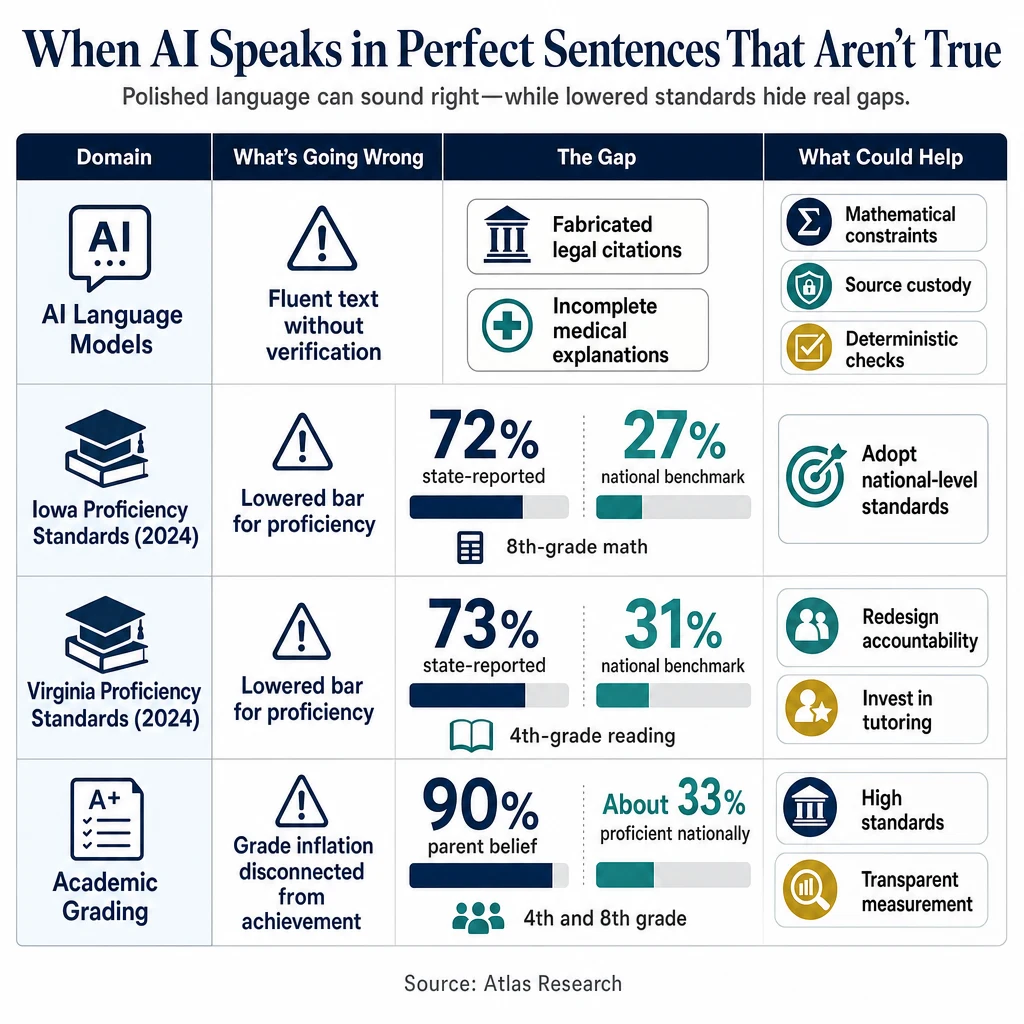
| Domain | Key Mechanism | Illustrative Gap | Proposed Solution |
|---|---|---|---|
| AI Language Models | Fluent text without verification | Fabricated legal citations, incomplete medical explanations | Mathematical constraint, source custody, deterministic checks |
| State Proficiency Standards (Iowa, 2024) | Lowered bar for proficiency | 72% state-reported vs. 27% NAEP (8th-grade math) | Adoption of NAEP-equivalent standards |
| State Proficiency Standards (Virginia, 2024) | Lowered bar for proficiency | 73% state-reported vs. 31% NAEP (4th-grade reading) | Accountability system redesign, tutoring investment |
| Academic Grading | Grade inflation disconnected from achievement | 90% parent belief vs. ~33% NAEP proficient (4th/8th grade) | High standards, transparent measurement |
The common thread across these domains is that confident language whether AI-generated or institutionally produced can mask the distance between expression and evidence. Bridging that gap requires not just better intentions but stronger infrastructure for verification.