Artificial intelligence is now capable of generating convincingly accurate-sounding but entirely fabricated information, posing a serious threat to trust in educational settings. This ability to “fluently lie” undermines the core purpose of learning - the pursuit of truth - and challenges educators to adapt to a new landscape of potential misinformation. The increasing sophistication of AI-generated text demands a reevaluation of how we assess student work and cultivate critical thinking skills.
Researchers at GenXis Research have named this phenomenon the Honesty Gap: the distance between persuasive language and verified truth. In their framing, the problem is not simply that AI systems make mistakes. It is that they make mistakes in fluent, reasonable, socially persuasive language the same polished form as their accurate answers. A legal citation can be fabricated in perfect legal prose. A medical explanation can sound clinically plausible while omitting a contraindication. A financial summary can appear authoritative while relying on stale facts.
The irony is that this same dynamic polished language obscuring unreliable substance has played out for years in American education, where state-reported proficiency rates have frequently diverged from national benchmarks. The result, in both AI systems and school accountability metrics, is the same: decision-makers trust what they are told, until they discover it was never quite true.
Defining the Gap: What Makes Language Slippery
At its core, the Honesty Gap is a problem of constraint. Natural language is flexible by design. It allows approximation, metaphor, implication, emphasis, ambiguity, and context dependence. Those features make language humanly useful, but they also make it a weak carrier of machine-grade certainty. Words can preserve signal. But they can also metabolize error into something that sounds reasonable.
In GenXis Research's foundational analysis, the researchers describe how small verbal deviations compound over time like a singer drifting slightly off pitch until the tonal center is lost entirely. "A sentence can feel precise while remaining logically incomplete," they write. "'This was handled responsibly,' 'the model is aligned,' 'the evidence supports the claim,' or 'the outcome was acceptable under the circumstances.' Each may be true, false, evasive, or meaningless depending on hidden definitions."
This squishiness has a name in the informal vocabulary of the internet: vibes and slop language that feels meaningful while carrying weak constraint. The researchers note that in human psychology, this drift is visible in motivated reasoning, cognitive dissonance reduction, moral disengagement, euphemistic labeling, and ethical fading. In AI systems, it appears as hallucination, unsupported synthesis, and citation-shaped language without source custody.
The central question the GenXis framework poses is deceptively simple: When does a sentence become a verified claim? Their definition formalizes this as a tuple the statement, the domain, the truth condition, and the evidence requirement. Without those elements, language remains expressive but under-bounded. It may point toward a reality without specifying the procedure by which that reality is checked.
The Educational Mirror: Where State Standards Drift from NAEP
The Honesty Gap is not exclusively an AI problem. Education policy researchers have used the same term to describe a structural divergence that has reshaped how American communities understand student performance.
According to Assessment HQ's analysis of national and state proficiency standards, the Honesty Gap is "the discrepancy between what a state and the National Assessment on Educational Progress (NAEP) each consider to be 'proficient.'" With academic recovery efforts stalled and policymakers sidestepping school accountability, the organization notes that lowering student expectations has become "an easy way to project success."
The data is stark. Assessment HQ utilized the new NAEP results released on January 29, 2025, along with their database of statewide summative assessment data for the 2023-24 school year. Their analysis reveals a consistent pattern: more states are lowering proficiency cut scores on their annual statewide assessments, obscuring student progress or the lack of it. "The warning signs are clear," they write. "States that lower proficiency standards may show exaggerated gains on Assessment HQ."
The Florida example illustrates the mechanics. According to Assessment HQ, Florida's "Proficient" standard is more aligned with NAEP than its "On Grade Level" benchmark. However, Florida uses "On Grade Level" a lower threshold for school accountability and public reporting, whereas most states use "Proficient." The result is a discrepancy that makes Florida's performance appear stronger on state metrics than it would under the national standard.
Assessment HQ notes that "some policy experts and advocates argue that the Honesty Gap still gives states too much credit." The structural mismatch between what states report and what NAEP measures creates a systematic inflation of apparent performance one that parents and taxpayers act on without realizing the underlying calibration has shifted.
Parents Are Noticing: The Grade Inflation Awakening
The consequences of this gap are not merely statistical. New data reported by The 74 in September 2026 suggests that parents are beginning to recognize the disconnect between what schools tell them and what students actually know.
Since 2022, the percentage of parents who think their children are at or above grade level in math has dropped 9 percentage points to 83%, according to data from Learning Heroes, a nonprofit focused on educating parents about their children's performance. In reading, the decline was 5 percentage points to 88%. The percentages are similar to early 2021, when pandemic school closures left clear evidence that children's performance was suffering.
"For years, over 80% of parents thought their kids were B students or better. New data shows that's changing."
Learning Heroes, via The 74, September 2026
Bibb Hubbard, Learning Heroes founder and CEO, acknowledges that a disconnect persists but the direction of movement matters. "In New York City, the percentage of parents reporting that their children were at or above grade level dropped 13 percentage points to 81% in math and 8 points to 87% in reading. In Tarrant County, Texas, which includes Fort Worth, declines went from 92% to 84% in math and 96% to 84% in reading.
This parental awakening has a parallel in the AI safety community. Just as parents are learning to question whether a B grade reflects actual mastery, technologists and policymakers are grappling with whether a confident AI response reflects verified knowledge or a well-formatted hallucination.
Why AI Amplifies the Problem
The GenXis Research framework argues that the AI era makes the Honesty Gap uniquely urgent. "Public concern about AI has intensified because language models now operate in domains where verbal mistakes have real consequences: legal drafting, medical triage, education, scientific writing, financial reporting, security analysis, and software development."
The key difference is not just frequency but form. Traditional misinformation often arrives with markers of unreliability poor grammar, suspicious sources, emotional manipulation. AI-generated content can arrive in impeccable prose, citing plausible-sounding authorities, organized around coherent structure. The surface indicators of quality that humans have learned to trust are present even when the underlying content is false.
"The worry is not merely that systems hallucinate," the GenXis analysis states. "The worry is that hallucinations arrive in the same polished form as true answers. In each case, the danger comes from the mismatch between linguistic confidence and verified grounding."
Educational technology has not escaped this dynamic. In a September 2026 Christianity Today report on AI and math education, Stacie Clark in her 35th year of teaching middle school and high school math in Colorado and Texas described how the presence of AI tools has changed the landscape: "We used to teach that math was a process of thinking with rules, and nowadays we teach students how to put it in a computer and cut out all the thinking."
Clark referenced the work of Jared Cooney Horvath, who in January 2026 gave written testimony to the US Senate about how "the rapid and largely unregulated expansion of educational technology" has stalled and at times reversed the cognitive development of children. Horvath reported "a structural mismatch between how human cognition develops and how digital platforms are engineered to capture attention, fragment focus, and accelerate task switching."
The parallel to the Honesty Gap is direct: when the appearance of learning outpaces the substance of learning, decision-makers at every level make choices based on maps that do not reflect the terrain.
The Math Wars Connection: Precision vs. Persuasion
The Christianity Today feature situates this tension within the long-running "math wars" debates about whether to teach mathematics through step-by-step algorithms or through conceptual understanding and analytical reasoning. "For decades, on campuses across the country, the math wars have been raging with a knockdown, drag-out brutality perhaps only rivaled by national politics," the report notes. "Public shouting matches, lawsuits, and character assassinations have surrounded a debate about how to teach students algebra and geometry."
William McCallum, who led the Common Core State Standards Initiative, explains the stakes: "It's the difference between giving students explicit instruction versus helping them find and understand the problems first. 'If you're going to teach a kid to ride a bicycle, are you going to show him a video of riding a bicycle or start by walking with him on the bicycle?'"
The question McCallum poses has direct relevance to AI systems. Showing a video of riding giving the appearance of understanding through polished demonstration is analogous to an AI generating fluent, confident responses. Walking with the bicycle building the underlying mechanics of comprehension is analogous to mathematical grounding that connects outputs to verifiable sources.
"No one wants students who can only simulate analytical thinking," McCallum concludes. "The debate is on how to train them in true intelligence."
The Antidote: Mathematical Constraint and Deterministic Grounding
If the Honesty Gap is the problem, what is the solution? The GenXis Research framework offers a clear answer: stronger grounding. "The antidote is not less language, but stronger grounding: mathematical constraint, source custody, deterministic checks, calibrated abstention, and evidence memory."
This approach reframes the role of mathematics in the AI conversation. Math is not merely a subject to be taught or a tool to be used it is a verification discipline. Mathematical statements have truth conditions that are checkable. A proof is either valid or it is not. An equation balances or it does not. The resistance to squishiness that makes mathematics difficult for some students is exactly the property that makes it valuable as a grounding mechanism for AI systems.
Calibrated abstention is a key component of this approach. When an AI system encounters a query it cannot answer with verified confidence, it should decline to answer rather than generating a plausible-sounding response. This requires a shift in how AI systems are designed and evaluated away from fluency metrics and toward calibration metrics.
Source custody ensuring that every verifiable claim traces back to a specific, checkable source is another pillar. This is analogous to the NAEP standard in education: a consistent, external benchmark against which claims can be measured. Without source custody, language floats free of verification, and the Honesty Gap widens.
Two Domains, One Dynamic
What emerges from this analysis is a striking structural parallel between AI honesty and educational accountability. In both cases, there is a gap between the language of performance and the reality of performance. In both cases, that gap is driven by systemic incentives: AI systems are trained to be helpful (which often means fluent), and school systems are pressured to demonstrate progress (which sometimes means lowering standards).
The consequences are similar too. Parents make decisions about tutoring, school choice, and college planning based on grades that may not reflect actual learning. Lawyers build cases around AI-generated precedents that may not exist. Patients follow medical advice from AI systems that may have omitted contraindications. Policymakers draft regulations based on AI analysis of data that may be fabricated.
The path forward is also similar. Mathematical grounding external benchmarks that resist the squishiness of natural language offers a way to anchor both AI outputs and educational metrics in verified reality.
State-by-State Discrepancies: A Snapshot
Assessment HQ's analysis provides a framework for understanding how the Honesty Gap manifests in practice. While the specific numbers vary by state, the pattern is consistent: states that lower proficiency standards report higher apparent student performance than NAEP would suggest.
The following comparison illustrates how state-reported rates can diverge from national benchmarks:
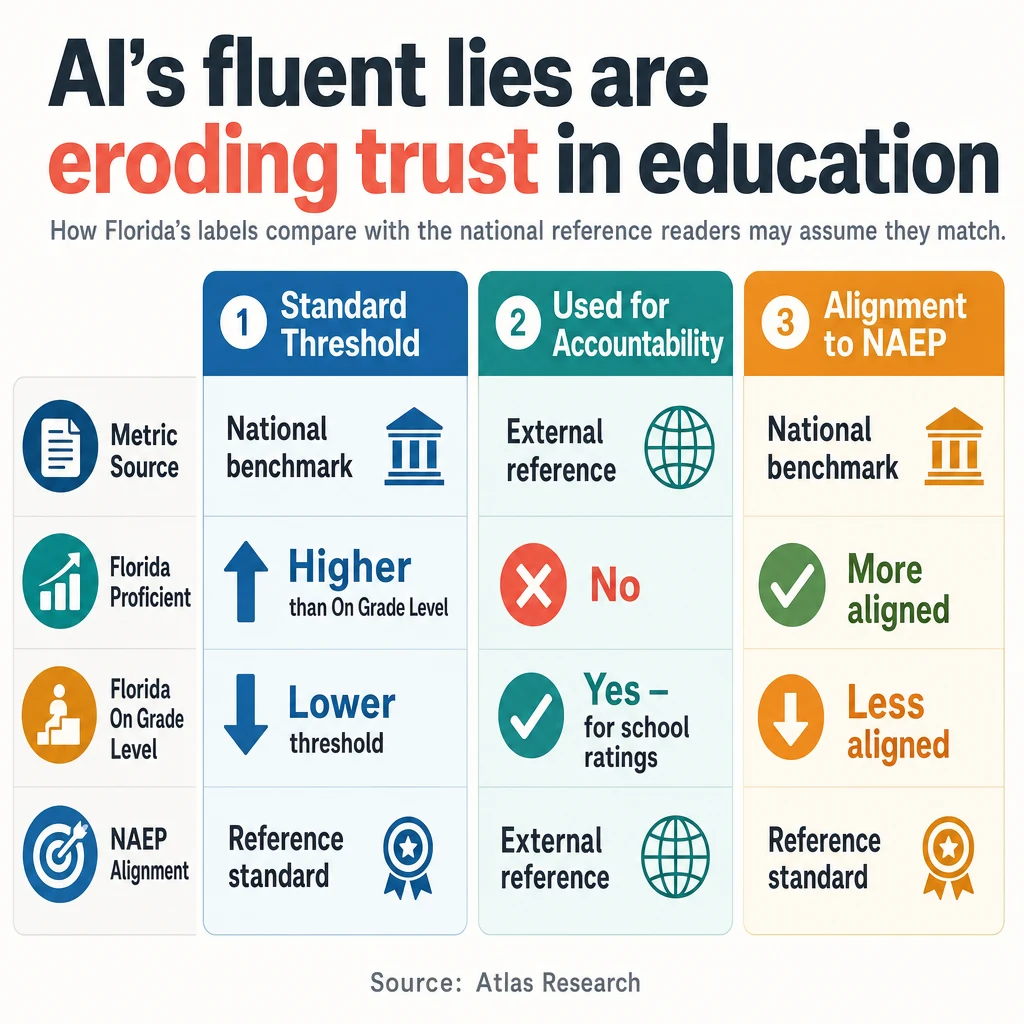
| Metric Source | Florida "Proficient" | Florida "On Grade Level" | NAEP Alignment |
|---|---|---|---|
| Standard Threshold | Higher than "On Grade Level" | Lower threshold | National benchmark |
| Used for Accountability | No | Yes for school ratings | N/A (external reference) |
| Alignment to NAEP | More aligned | Less aligned | Reference standard |
The key insight is that Florida uses its lower threshold for public reporting the number parents see, the number that appears in news coverage, the number that shapes perceptions. The higher threshold, which would be more honest by the NAEP standard, is not what decision-makers typically encounter.
This is the Honesty Gap in structural form: not a single deception, but a systematic divergence between the metric used for accountability and the metric that reflects reality.
Why This Matters for GenXis Research Readers
For practitioners, frameworks-builders, and researchers who work with AI systems or educational data, the Honesty Gap is not an abstract philosophical problem it is a practical risk with real consequences. Every confident AI response that lacks source custody is a potential liability. Every state proficiency report that diverges from NAEP is a potential misdirection.
The framework emerging from GenXis Research offers a way to think about this problem systematically. The solution is not to trust AI less or to abandon standardized testing it is to build verification infrastructure that makes the gap visible and bridgeable. Mathematical constraint. Source custody. Deterministic checks. Calibrated abstention.
This is not a call to distrust technology or to despair of educational reform. It is a call to build systems that are honest about what they know and what they do not systems where the language, however fluent, remains tethered to verifiable ground.
Where to Read Further
For readers who want to explore the Honesty Gap framework in its original formulation, GenXis Research's analysis "The Honesty Gap: Words Vs. Math" provides the foundational definitions, the mathematical grounding, and the detailed discussion of how language drifts and how verification anchors.
For a practical application in educational accountability, Assessment HQ's Honesty Gap resource maps state-by-state discrepancies between local proficiency standards and NAEP benchmarks, offering a concrete dataset for understanding how the gap manifests in policy.
For the intersection of AI and mathematics education, Christianity Today's September 2026 feature on the math wars provides context on the long-running pedagogical debate and how AI tools are reshaping and complicating the challenge of teaching students to think mathematically rather than merely procedurally.
Finally, for data on how parents are increasingly recognizing the gap between perception and reality in student performance, The 74's reporting on Learning Heroes survey data tracks the shifting landscape of parental awareness and its implications for education policy.
The Honesty Gap will not close itself. But the infrastructure to understand it, measure it, and ultimately bridge it is already taking shape in research frameworks, in accountability metrics, and in the growing awareness that fluency and truth are not the same thing. The next step is building systems worthy of that distinction.